- Main page
- Information Center
- Government News
Government News
Visit korean.net to see a variety of policies and relevant news of the Korean government.
Community-integrated care combines medical, nursing, welfare
- Source
- korea.net
- Date
- 2026.03.31
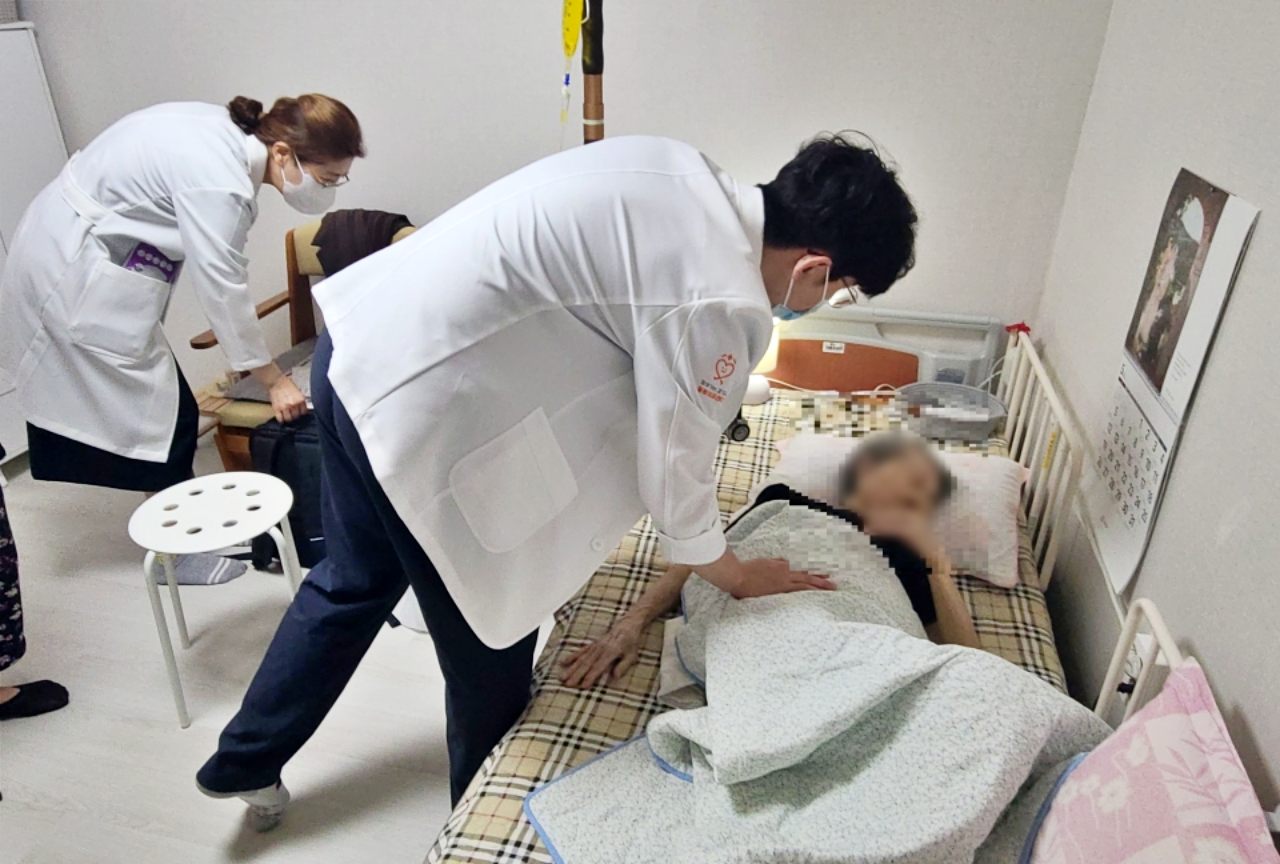
Staff from Gyeonggi-do Province's visiting medical care center visit a patient's home to provide services. (Gyeonggi Provincial Office)
By Kim Hyelin
A "community-integrated care" system launched nationwide on March 27 provides needed care for senior citizens and disabled people at their homes instead of hospitals or medical facilities.
A 2023 survey conducted by the Ministry of Health and Welfare on elderly people found that 87.2% of respondents wanted to continue living at home as their preferred residence, with 48.9% saying they wished to stay at home even if deteriorating health made independent living difficult.
Another study done the same year on disabled people discovered that 84.8% of them age 19 or above suffered from an average of 2.5 chronic diseases, showing the necessity for comprehensive medical and caregiving support. Yet people seeking medical, nursing and welfare services had to visit each relevant facility in person, however, under a fragmented and inconvenient system.
The new system aims to improve things. A "one-stop" service starts with just one application at the administrative and welfare center of a town, township or neighborhood or the National Health Insurance Service. A customized support plan is devised after a comprehensive assessment of an individual, and services in health care, health management, long-term care and daily living support are integrated and linked.
The new service came after on-site verification following a pilot project from 2019-22 involving 16 cities, counties and districts and another from 2023-25 involving 12. Dubbed a national benchmark, Jincheon-gun County, Chungcheongbuk-do Province, has seen impressive results after running the project for seven years.
The county has raised the proportion of senior citizens and disabled people living at home rather than hospitals or medical facilities after discharge, saving over KRW 1.5 billion every year in long-term care benefits for the elderly.
In the nation's fifth-biggest city of Daejeon, Yuseong-gu District reduced the risk of re-hospitalization by deploying staff to visit the homes of high-risk senior citizens living alone to provide them with medical care and nutritious meals. Daedeok-gu District reduced the depression index of caregivers 79% through a program for elderly patients with mild dementia.
A survey on the project showed that 69.8% of caretakers said their work burden declined thanks to the new integrated system.
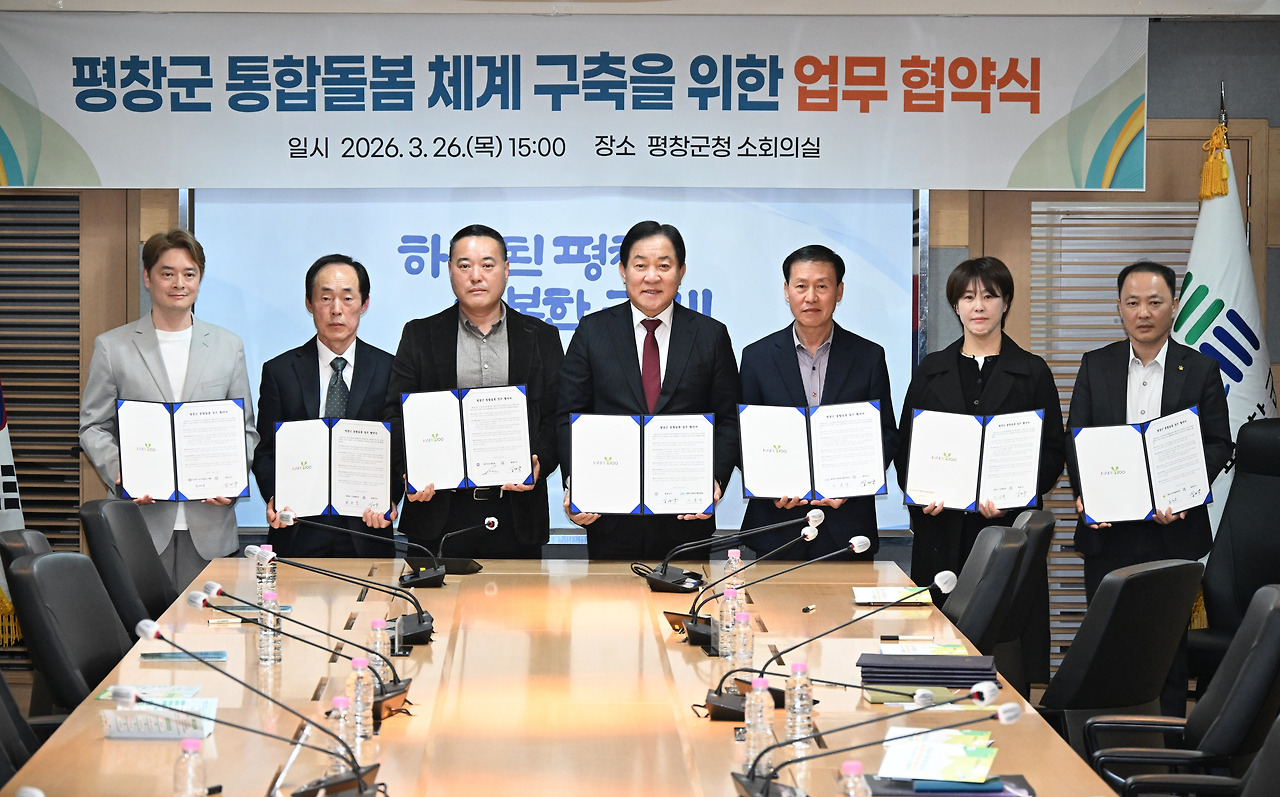
Pyeongchang-gun County, Gangwon-do Province, on March 26 concludes a memorandum of understanding with six specialized agencies to set up an integrated care system. (Pyeongchang County Hall)
To ensure that the system is successful, financial support and personnel infrastructure have received major boosts. The relevant budget this year was set at KRW 91.4 billion, up nearly 13-fold from KRW 7.1 billion last year and KRW 62 billion of the amount invested in more regional services.
Differential support goes to each local government based on factors such as the aging rate and if the region is medically underserved. A combined 5,346 personnel for the system have been deployed to 229 cities, counties and districts nationwide, and a referral network of 1,162 contracted hospitals refer to local governments patients scheduled for discharge but still require care.
An estimated 2.42 million senior citizens and disabled people need comprehensive support. Those eligible are selected based on their care needs regardless of income, thus the scale of assistance will gradually expand starting with high-risk people who urgently need care.
The system also targets underprivileged areas that lack social services such as islands and remote areas. From next month, the ministry will provide integrated care customized for each of six regions: Incheon, the provinces of Gangwon-do, Chungcheongnam-do, Jeollabuk-do and Jeollanam-do, and Jeju Island.
Care using artificial intelligence-based robots will be offered in the island countries of Goheung-gun, Wando-gun, Jindo-gun and Sinan-gun in Jeollanam-do. Biyangdo Island in Jeju will run a service integrating support for life and mental health.
The plan is to complete the system in stages with the launch being a starting point. Thirty core services will be integrated first in the introductory phase until 2027, and the scope of support will be expanded to the mentally ill during the stabilization phase from 2028.
Entering the advanced phase in 2030, the number of services will be expanded to 60 including home rehabilitation, hospital accompaniment and hospice care. From July this year, a basic five-year plan for integrated support will be devised based on surveys for the system to stably take root.
kimhyelin211@korea.kr