- Main page
- Information Center
- Government News
Government News
Visit korean.net to see a variety of policies and relevant news of the Korean government.
AI crackdown seeks to prevent deepfake fraud in local elections
- Source
- korea.net
- Date
- 2026.04.16
The Ministry of the Interior and Safety and the National Forensic Service have developed a deepfake detection and analysis model based on artificial intelligence for use in this year's local elections on June 3. (iClickArt) Unauthorized reproduction and redistribution of this image is prohibited under copyright law.
By Yoo Yeon Gyeong
An artificial intelligence (AI)-based detection technology will be used in the June 3 local elections to prevent the spread of false content using deepfakes.
The AI deepfake detection and analysis model jointly developed by the Ministry of the Interior and Safety with the National Forensic Service (NFS) will be used in the local elections on June 3.
This is to prevent false information about candidates from distorting voter judgment, as deepfake content that sophisticatedly synthesizes people's faces or voices has recently surged.
This model was developed using the results of a contest in December last year for AI detection models to counter deepfake crime, with 1,077 contestants spanning 268 teams competing.
The ministry and the NFS will provide the five outstanding models they selected to the National Election Commission. In addition, another system will support the rapid evaluation and analysis of dubious video or audio content during the election period.
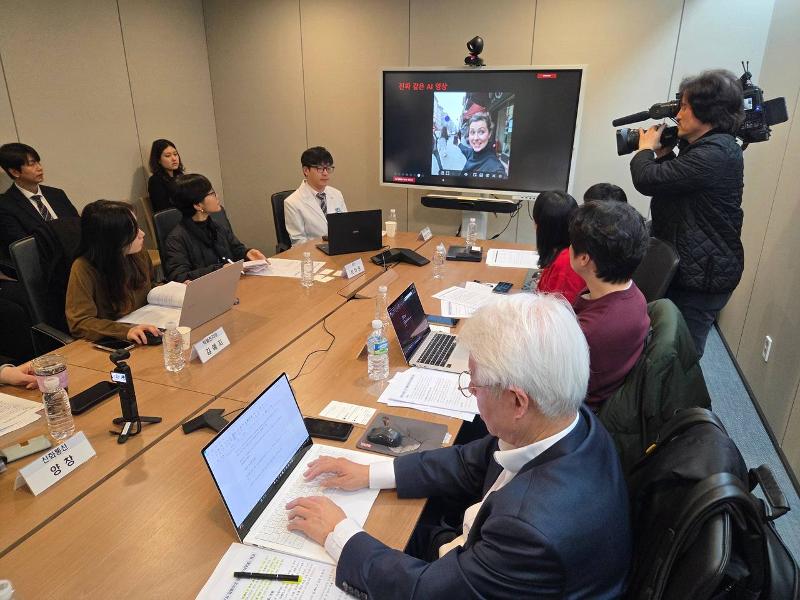
The Ministry of the Interior and Safety and the National Forensic Service on March 19 host a policy briefing for foreign media on the AI deepfake detection and analysis model at KOCIS Center in Seoul's Jung-gu District. (Ministry of the Interior and Safety)
The model enhances detection accuracy by simultaneously conducting "global analysis" of a video's entire flow and "local analysis" to determine which details such as faces have been forged. The detection accuracy rate is about 92%, far higher than 76% of the former model.
The ministry and the NFS will gradually expand the scope of using deepfake analysis models. They will cooperate with relevant departments like the Ministry of Gender Equality and Family, Korea Media and Communications Commission, and Korean National Police Agency to streamline the pan-government response to digital crimes.
"Highly sophisticated AI deepfake disinformation seriously threatens electoral democracy," Minister of the Interior and Safety Yun Ho Jung said. "The government will keep raising its ability to respond to false and manipulated information during the election process to prevent violation of the people's fundamental rights and create a competent and trustworthy democratic government driven by AI."
dusrud21@korea.kr